Genre: General Fiction, Historical Fiction
We all know Elizabeth Bennet's and Mr. Darcy's story, and we know about Jane and Mr. Bingley, Lydia and Mr. Wickham, and even a few sentences about what happens to Kitty. But what about that bookish, Goth-before-it-was-cool sister, Mary Bennet? What ever happens to her? While Jane Austen was content to leave her readers laughing at Mary's social foibles and pedantic sermonizing in everyday conversation, Jennifer Paynter decides to reveal the "Forgotten Sister's" story in her fan-fiction-esq book.
Overall, I thoroughly enjoyed this first-person novel, and it really made me sympathetic towards Mary as a character while generating annoyance with her popular elder sisters. While Paytner does not shy away from detailing Mary's awkward piano playing at the ball at Netherfield or her ability to say precisely the wrong thing at the wrong time, she allows us a look into Mary's thought processes and her backstory: a long illness and a deep clinical depression that left her looking less pretty than her sisters, a stint away for her family where she learned to read and memorize to control her anxiety, and a genuine faith in God to help her in her most lonely moments. From Mary's point of view we see not just the silliness of Lydia and Kitty, but also the selfishness of Elizabeth and Jane in excluding Mary, albeit sometimes unintentionally, from their company. We see a character very self-aware and more embarrassed of herself than her family is of her when she makes public mistakes.
My only criticism of the book, which was well-written and engaging, is Paynter's obvious nods in Mary's voice to the story we all know of Pride and Prejudice. This ripped me out of the world of the story somewhat, as if the fictional Bennets were aware that Jane Austen was writing a book about them, and it would've been more effective to just let Mary tell her story as if we've never heard it before.
For all her trouble, Paynter writes Mary a happy ending and you'll have to read the book to find out for yourself what that is. But this book reminded me that no matter what we see on the outside of a person, much more might be happening in their hearts, and we would do well to welcome the outcasts in. They might have a lot more to tell us than we think.
O for a book/And a shady nook/Either indoors or out/with the green leaves whispering overhead/Or the street cries all about/Where I may read/at all my ease/Both of the new and old/For a jolly good book/Whereon to look/Is better to me than gold! ~John Wilson
Showing posts with label Historical Fiction. Show all posts
Saturday, February 14, 2015
Friday, December 7, 2012
Menfreya in the Morning by Victoria Holt
Genre: General Fiction, Historical Fiction
Book Summary: Harriet Delvaney has always been fascinated with Menfreya, an old mansion with a mysterious history. When she marries into the family and becomes heiress of the Menfreya estate, she finds out just how dark and dangerous that history is, and how her own life might be in danger.
Indulgent Book Talk: One of my good friends has always been a fan of Victoria Holt novels, which is just one of the many pen-names of a single author, and she recommended and lent them to me. This book is marketed as a romance, but I think it follows more of a Gothic novel line, like Jane Eyre. It was an easy, suspenseful, quick read.
Glorifying Elements: Harriet's character is a strong one, and she is good at rising above some of the hard situations in her life. On the other hand, she is also quick in the first person narrative to admit her faults, especially her emotions that she knows are selfish. She also cares for people, like her best friend, when the rest of the world would ordinarily reject that person.
Worldly Elements: Harriet does not always act perfectly, and can often be quite rebellious against her family. She is also has a tendency to be suspicious of others and assume the worst in them, especially in her own husband, which bothers me personally. This book also deals with murder and death quite a bit, has an instance of a child being born out of wedlock, and a few mild sexual references.
General Recommendation: For a quick, entertaining read, this is a good pick.
Book Summary: Harriet Delvaney has always been fascinated with Menfreya, an old mansion with a mysterious history. When she marries into the family and becomes heiress of the Menfreya estate, she finds out just how dark and dangerous that history is, and how her own life might be in danger.
Indulgent Book Talk: One of my good friends has always been a fan of Victoria Holt novels, which is just one of the many pen-names of a single author, and she recommended and lent them to me. This book is marketed as a romance, but I think it follows more of a Gothic novel line, like Jane Eyre. It was an easy, suspenseful, quick read.
Glorifying Elements: Harriet's character is a strong one, and she is good at rising above some of the hard situations in her life. On the other hand, she is also quick in the first person narrative to admit her faults, especially her emotions that she knows are selfish. She also cares for people, like her best friend, when the rest of the world would ordinarily reject that person.
Worldly Elements: Harriet does not always act perfectly, and can often be quite rebellious against her family. She is also has a tendency to be suspicious of others and assume the worst in them, especially in her own husband, which bothers me personally. This book also deals with murder and death quite a bit, has an instance of a child being born out of wedlock, and a few mild sexual references.
General Recommendation: For a quick, entertaining read, this is a good pick.
Friday, September 14, 2012
Wildflowers of Terezin by Robert Elmer
Read on my Kindle!
Genre: Historical Fiction, Christian Fiction
Book Summary: Steffen Petersen, a young Lutheran pastor, was perfectly content to stay out of politics and preach positive sermons from his pulpit. But his accidental friendship with a Jewish nurse, and hearing that the Nazis are rounding up the Jews in his homeland of Denmark, throws him into a crisis of faith. He his forced to decide whether he will practice what he preaches, and what exactly that cost might be to himself and those he loves the most.
Indulgent Book Talk: Ah, another one of my World War II/Holocaust indulgences. I'm not really sure why this period of history fascinates me so much, considering how morbid it is. Then again, I've taken to looking up diseases I find mentioned in books and looking up their symptoms to find out exactly how nasty they really are, so maybe I am morbid. I'm not sure. I think I like this period of history so much because it brought out the worst, and therefore, the best, in humanity. It was a time when what was good and what was evil seemed very clear. The author does of good job of not only shaking his characters from their comfort zones, but challenging his readers to do the same, especially when it comes to, in the words of the great Albus Dumbledore, "deciding between what is easy and what is right."
Glorifying Elements: This book is mainly about a pastor who is thrust into the heat of the Holocaust drama, and who finds himself having to prove whether his faith in God is real or not; whether it's something that's just for when life is comfortable and safe, or whether it is faith for when times are evil and days are dark. I think as believers, we are all forced to make that decision at some point in our lives, and this fictional account is encouraging. (SPOILER ALERT!) Likewise, Steffen's love for a Jewish woman and his peace with God in the midst of frightening events draws her to the Savior, and that too is beautiful.
Worldly Elements: Holocaust stories are always a little disturbing; they should be. Elmer keeps it fairly tame though, focusing on his characters more than on carnage. But you can expect some violence, blood, and disturbing depictions, but nothing gratuitous. I'd give this novel a PG rating.
General Recommendation: I love stories about people doing the right thing in the midst of great danger. If that kind of thing tugs at your heartstrings like it does mine, then you will likewise find this book a worthy read.
Genre: Historical Fiction, Christian Fiction
Book Summary: Steffen Petersen, a young Lutheran pastor, was perfectly content to stay out of politics and preach positive sermons from his pulpit. But his accidental friendship with a Jewish nurse, and hearing that the Nazis are rounding up the Jews in his homeland of Denmark, throws him into a crisis of faith. He his forced to decide whether he will practice what he preaches, and what exactly that cost might be to himself and those he loves the most.
Indulgent Book Talk: Ah, another one of my World War II/Holocaust indulgences. I'm not really sure why this period of history fascinates me so much, considering how morbid it is. Then again, I've taken to looking up diseases I find mentioned in books and looking up their symptoms to find out exactly how nasty they really are, so maybe I am morbid. I'm not sure. I think I like this period of history so much because it brought out the worst, and therefore, the best, in humanity. It was a time when what was good and what was evil seemed very clear. The author does of good job of not only shaking his characters from their comfort zones, but challenging his readers to do the same, especially when it comes to, in the words of the great Albus Dumbledore, "deciding between what is easy and what is right."
Glorifying Elements: This book is mainly about a pastor who is thrust into the heat of the Holocaust drama, and who finds himself having to prove whether his faith in God is real or not; whether it's something that's just for when life is comfortable and safe, or whether it is faith for when times are evil and days are dark. I think as believers, we are all forced to make that decision at some point in our lives, and this fictional account is encouraging. (SPOILER ALERT!) Likewise, Steffen's love for a Jewish woman and his peace with God in the midst of frightening events draws her to the Savior, and that too is beautiful.
Worldly Elements: Holocaust stories are always a little disturbing; they should be. Elmer keeps it fairly tame though, focusing on his characters more than on carnage. But you can expect some violence, blood, and disturbing depictions, but nothing gratuitous. I'd give this novel a PG rating.
General Recommendation: I love stories about people doing the right thing in the midst of great danger. If that kind of thing tugs at your heartstrings like it does mine, then you will likewise find this book a worthy read.
Tuesday, September 4, 2012
Christy by Catherine Marshall
Genre: Christian Fiction, Historical Fiction
Book Summary: It is 1912, Christy Henderson is 19 years old, idealistic, passionate, and hopelessly naive. When a missionary speaks at her church about a needy rural community called Cutter Gap in the Great Smokies of Tennessee, Christy jumps at the opportunity to be a school teacher to this group of desperately poor, prideful people. She quickly learns not only about the extreme hardships these people face, but also about the darkness of her own heart and soon learns that perhaps God put her there not so that she could help, but so that she would know Him more deeply.
Indulgent Book Talk: Normally, I'm very much an advocate for reading the book before watching the movie, but I first heard about Christy as the television mini-series starring Kellie Martin. On a Bookman's trip several months back I stumbled across this book, not knowing it even existed. I finally got around to reading it. It inadvertently sets itself up well to be a mini-series, since there is not one cohesive plot line, but is rather more episodic in structure. However, if any book needed an epilogue, it is this one! I was unimpressed with the ending, and felt the author had run out of steam and wrapped it up a little too quickly or conveniently for my tastes.
Glorifying Elements: I think one of the main points this book flushes out is how we should operate as missionaries to a needy world. Christy has to learn, usually the hard way, that she must function within the culture she has been placed in, rather than imposing her ideas and ways of doing things on people who have lived the way they have for generations. It is only when she begins to learn humility and patience with people she often doesn't understand does she make it through to their hearts. Also, Christy's personal faith journey is interesting in that she learns she must trust in Jesus and know what she believes for herself, that she doesn't just inherit her parents' faith.
Worldly Elements: The health-and-wealth gospel turns up fairly frequently in this novel. Even more irritating, at least to me, was the promotion of open theism (for a definition of open theism, go here). The author suggests that God is helpless to stop the evil, that it all depends on our obedience, and that He really doesn't have sovereign control over it. To make my point clearer, one of the characters, Miss Alice, tells Christy about a little girl who was raped and murdered by her step-father. Miss Alice says that the reason that happened was because a man was told by the Holy Spirit that this was going to happen, but he did nothing to stop it. This character asserts that evil happens because people decide not to stop it. That is just ludicrous. Some terrible things happen entirely out of people's control because we live in a fallen, sinful world. God, however, is not surprised by evil or frustrated by our disobedience. His will is done, regardless. At one point, frustrated by evil and bad things happening, Christy reads Job. I wish the profound principles about the nature of evil in that book had been discussed more biblically in the novel.
General Recommendation: Overall, this book is an engaging read. If you don't read it for serious theological information and are discerning about some of the teaching in it, then it has its merits as a good curl-up-with-a-cup-of-tea book.
Book Summary: It is 1912, Christy Henderson is 19 years old, idealistic, passionate, and hopelessly naive. When a missionary speaks at her church about a needy rural community called Cutter Gap in the Great Smokies of Tennessee, Christy jumps at the opportunity to be a school teacher to this group of desperately poor, prideful people. She quickly learns not only about the extreme hardships these people face, but also about the darkness of her own heart and soon learns that perhaps God put her there not so that she could help, but so that she would know Him more deeply.
Indulgent Book Talk: Normally, I'm very much an advocate for reading the book before watching the movie, but I first heard about Christy as the television mini-series starring Kellie Martin. On a Bookman's trip several months back I stumbled across this book, not knowing it even existed. I finally got around to reading it. It inadvertently sets itself up well to be a mini-series, since there is not one cohesive plot line, but is rather more episodic in structure. However, if any book needed an epilogue, it is this one! I was unimpressed with the ending, and felt the author had run out of steam and wrapped it up a little too quickly or conveniently for my tastes.
Glorifying Elements: I think one of the main points this book flushes out is how we should operate as missionaries to a needy world. Christy has to learn, usually the hard way, that she must function within the culture she has been placed in, rather than imposing her ideas and ways of doing things on people who have lived the way they have for generations. It is only when she begins to learn humility and patience with people she often doesn't understand does she make it through to their hearts. Also, Christy's personal faith journey is interesting in that she learns she must trust in Jesus and know what she believes for herself, that she doesn't just inherit her parents' faith.
Worldly Elements: The health-and-wealth gospel turns up fairly frequently in this novel. Even more irritating, at least to me, was the promotion of open theism (for a definition of open theism, go here). The author suggests that God is helpless to stop the evil, that it all depends on our obedience, and that He really doesn't have sovereign control over it. To make my point clearer, one of the characters, Miss Alice, tells Christy about a little girl who was raped and murdered by her step-father. Miss Alice says that the reason that happened was because a man was told by the Holy Spirit that this was going to happen, but he did nothing to stop it. This character asserts that evil happens because people decide not to stop it. That is just ludicrous. Some terrible things happen entirely out of people's control because we live in a fallen, sinful world. God, however, is not surprised by evil or frustrated by our disobedience. His will is done, regardless. At one point, frustrated by evil and bad things happening, Christy reads Job. I wish the profound principles about the nature of evil in that book had been discussed more biblically in the novel.
General Recommendation: Overall, this book is an engaging read. If you don't read it for serious theological information and are discerning about some of the teaching in it, then it has its merits as a good curl-up-with-a-cup-of-tea book.
Monday, August 20, 2012
Behold the Dawn by K.M. Weiland
Read on my Kindle!
Genre: Historical Fiction, Christian Fiction
Book Summary: Marcus Annan has secrets, and he would prefer them to stay that way. However, the Crusades are in full swing, and a rogue monk, a war, and a woman in dire need of his help threaten to reveal those secrets and endanger not just Annan's life, but the lives of those around him as well. This is a really moving story of redemption and never being too far gone to be saved, even from oneself.
Indulgent Book Talk: I have been following the author's blog for some time now; she gives good writing advice and motivation for aspiring authors (you can find it here). Anxious to read something with a good story, and having an inkling that the Weiland was a Christian, I picked up this book. I was not disappointed. Weiland is not only a strong writer, but she also has a no-nonsense way of telling stories that I really admired. Her facts are well-researched (as far as I can tell, being by no means an expert on twelfth-century history), and her characters are believable and realistic. She also succeeds well at what I think Christian authors should be doing; that is, crafting a compelling story in its own right that reflects the love and truth of the Gospel without coming across as preachy or trite. Hurrah!
Glorifying Elements: This entire book presents the Gospel well, as I have already said. Specifically, through the troubled character of Annan, she really drives home the totality of Jesus' salvation and love for sinners. All without sounding like a gospel tract or resorting to Amish women in bonnets! Hip Hip Hurrah! She also discusses the fact that the Crusades were not representative of real Christianity, but rather a bi-product of the corrupt Roman Catholic church (the only one at the time, since this is pre-Reformation) and power-hungry government leaders.
Worldly Elements: Nothing remotely gratuitous. You can give this book a good solid PG. There is some violence (this is the Crusades, after all), but the description is restrained. There is also a mention of an intimate relationship between a husband and a wife, but again, no specific descriptions. Bad language is non-existent, except for some historical insults and name calling.
General Recommendation: A definite yes. If you have a Kindle, this one is less than $5 too. :-)
Thursday, April 12, 2012
Hotel on the Corner of Bitter and Sweet by Jamie Ford
Read on my Kindle!
Genre: Historical Fiction
Book Summary: Henry, the twelve-year-old child of
Chinese immigrant parents, is growing up in Seattle during World War II. In
order to attend the all-white public school he goes to, he has to work in the
kitchen during lunchtime. When a Japanese girl, Keiko, joins the school and the
kitchen staff, they develop a forbidden friendship, and later something deeper,
that is further complicated when Keiko and her family are sent to an internment
camp in the wake of the Pearl Harbor attacks.
Indulgent Book Talk: This is one of those books that just
works. I don’t know how to say it other than that. It’s not groundbreaking,
it’s not the best-written book I’ve ever read, the subject matter is fairly
tried and true, and in fact stands as a very traditional novel. But for that
reason, I found it refreshing and enjoyable. Plus, it had a happy ending. These
books very often end up unhappy, and sometimes I think authors find it trendy
to end their books in sad ways. Ford, on the other hand, wanted the readers to
feel good at the end of the book. And he doesn’t disappoint. The book is
structured to take place in two time periods, one of them during World War II,
and the other in the 1980’s, when Henry’s life is very different. It was easy
to follow.
Glorifying Elements: The main theme that stood out to me in
this novel was the triumph of ordinary human goodness. This played out in
Henry’s feeling about the internment camps, in his loyalty to Keiko and her
family, and ultimately (SPOILER ALERT), his commitment to his wife even as she
dealt with a fatal illness. Henry lived in a complicated time period, and he
acts nobly much of the time.
Worldly Elements: There is no need to rate this book above
PG. There is no sexual content except a chaste kiss or two between teenagers,
no violence except some encounters with school bullies, and no cursing
whatsoever. Henry does disobey his parents, which of course goes against God’s
commands, but he is a very human character.
General Recommendation: Yes. Definitely a nice, redemptive read
with interesting characters in a fascinating time period.
Thursday, October 20, 2011
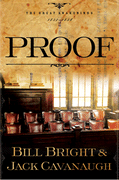
Proof by Bill Bright and Jack Cavanaugh
Genres: Christian Fiction, Historical Fiction, Political Thriller
Book Summary: I’ve really been on a Christian lit kick these last few weeks. I zoomed through this random Bookman’s find, co-authored by Campus Crusade for Christ’s late founder, Bill Bright, and hope to find the others in The Great Awakenings series. This book follows the story of a young lawyer named Harrison Shaw, who finds himself in the middle of America’s revival in 1857-58. He gets himself tangled up in the mysterious life of Victoria Jarves, the daughter of New York City’s most successful and vicious lawyer, and the tumultuous climate of 1850’s New York leads to this novice attorney defending Christianity in a court of law.
Indulgent Book Talk: I found this book really enjoyable and engaging. The writing was very smooth and readable, and the characters were interesting. I especially thought the depiction of the book’s villain, J.K. Jarves, was particularly chilling and well thought-through. Victoria Jarves’ antics made for some interesting plot twists, and Harrison Shaw, the story’s main protagonist, was a believable, imperfect character. Well done on those accounts. With its heavy spiritual themes, I don’t think this would be the kind of Christian literature that would appeal to those outside of the faith, but for those of us on the inside, it’s delightful fun and encouraging.
Glorifying Elements: One of the things I think this book did well was present a clear gospel message. It emphasized sin and people’s need for a Savior within the context of a spiritual revival. I also thought the role of the Holy Spirit was conveyed accurately—something I was concerned about when I bought it because I didn’t want it to be too charismatic; it wasn’t. It’s rare that you find a gospel message portrayed in a non-preachy, contrived way and solely through the lives and conversations of the characters; I really thought that gave the writing a lot of credibility.
Negative Elements: Not much. Definitely rated G in content. In fact, the character of Harrison Shaw is one of those kinds of gentlemen we women like to admire in Jane Austen-type literature. J.K. Jarves was a bit disturbing as a character, but not in a gratuitous way. The only real problem I had with the book, even though it was quite entertaining, is that I don’t think the trial that occurred at the end could actually happen. Even with manipulative lawyers and a corrupt system (which, realistically, it is to some extent), I think it would take a lot more than a personal vendetta to bring a whole church to trial for “poisoning people’s minds.” Though I am certainly not an expert in the law, I’m still not sure which law they’d have to cite to get a serious trial to court, especially considering free speech and freedom of religion, which was much more highly regarded in those days than it is now. Nevertheless, I’m accustomed to suspension of disbelief when I’m reading fiction, so this did not interfere too much with my enjoyment of this book.
General Recommendation: Go for it, especially if you are fond of the genres this book falls into. It’s a light, fun read, and I hope to find the books in the other series. When I do, I’ll let you know!
Friday, August 12, 2011
Washington's Lady by Nancy Moser
Genre: Christian Fiction: Historical
Book Summary: If you paid attention in U.S. History classes, or know anything about the life of the first president of the United States of America, then you probably already have an idea of what the plot of this book is like. In first-person narrative, it follows the life of Martha Custis Parke Washington, and, if what the author claims is true about her research, sticks to historical fact pretty closely. Martha married young, her husband died after seven years of marriage, and then, with two young children in tow, Martha meets and marries an up-and-coming military colonel, George Washington. Through life’s ups and downs, and a nation that is quickly and violently changing, Martha learns to trust God with the unexpected, whether good or bad.
Indulgent Book Talk: I know it is far too often said that you can’t tell a book by its cover, but I will admit, the pretty colonial-period dress on the front of this paperback immediately drew my attention. Aside from that, I found the book to be an enjoyable, if unremarkable, read. With family on the east coast, I’ve been to many of the places mentioned in the book, including Mount Vernon, George Washington’s plantation, so it was fun to have a real-life picture in my head of the novel’s settings. I loved reading this for its refresher on American History, and was glad that I still remembered the facts about our nation’s beginnings from my AP U.S. History class 9 years ago.
This book is well-written, though not groundbreaking in its style. While the plot moved along nicely and held my interest, the author falls into a habitual “Martha” voice that starts to get a little old after awhile. Ending each section or chapter on a one-worded train-of-thought was interesting the first ten times but started to annoy me as the book progressed. I also got the feeling as I kept reading that even the author was tiring of her book; towards the end, it started to read more like at textbook, and the family-life and Martha’s internal struggles that made the story more three-dimensional and dynamic got lost in the dry historical narrative.
Nevertheless, I did like how the author flushed out the characters’ faith and how that informed (or, to their harm, didn’t inform) their decisions.
Glorifying Elements: As a novel published by a Christian company and written by a Christian author, there is much good to be said about the book. Moser flushes out several things that I think are key and sadly missing from our culture. This is what struck me the most:
1. The faith of the forefathers: Granted, many of these people were not Christians in the Biblical sense of the word. Nevertheless, they seemed to work towards a common goal of instilling Judeo-Christian principles of equality and human value and dignity into the infant nation. We have much to be grateful for, especially as Christians. Without our forefathers’ commitment to Christ, we would not enjoy the freedoms we do.
2. Trusting God: One of the big ways that Martha grows as a character is her ability to trust God, even with the worst that life can bring her. She begins the novel as a person who is angry at God for taking away her first husband, some of her children, and other relatives. She vows to keep her loved ones close so that they will not die on her. But as the novel progresses and tragedy inevitably strikes again, she learns that she must trust God to be good even when life is painful and difficult. She’s never perfect, but she comes to surrender her life and the lives of her loved ones to God.
3. Good parenting: This is sort of a weird one, maybe, but this was a first time in a book where I saw a character admit that the way a child turned out was the fault of the parent. Martha (and this is historically true as well, apparently), was never good at disciplining her children, so her son turned out to be rather wild and immature. Later in the book, she expresses regret over her decisions as a parent. As a hopeful future parent, it was a good lesson for me in raising children the right way.
Worldly Elements: Because this is a Christian book, there is very little objectionable material. Sex is talked about, but only as it pertains to a husband and a wife, and in very eighteenth century ways (so subtle and polite). It never struck me as dirty or inappropriate. There is no bad language to speak of, no violence. With any Christian fiction, one has to be careful to not read the book as theology, and to always line up the character’s actions and inner dialogue with Scripture. But there was nothing in this book that struck me as Biblically incorrect, at least not in a way that concerned me.
General Recommendation: Yes! If you’re into historical fiction, this one was a nice read. As I said before, I lost interest towards the end because it started to read more like a history textbook and less like an interesting individual narrative, but I still enjoyed it.
Tuesday, July 26, 2011
Tallgrass by Sandra Dallas
Genre: Historical Fiction
Book Summary: Set on America’s home front during World War II, this story follows the coming-of-age of Rennie, who lives on a farm with her parents. When a Japanese internment camp opens up in her eastern Colorado town of Tallgrass, her predictable world is upset. When one of her friends is mysteriously murdered, attentions turn to the Japanese camp for the culprit. Throughout the novel, Rennie is forced to grow up as she deals with illness, racism, secrets, and war.
Indulgent Book Talk: There is one main element that I think Dallas did really well with the writing of this novel, and that is her ability to make you discover what’s going on right along with Rennie. The first person point of view helps with this. As a reader, Dallas compels you to assume what Rennie assumes. Her thought processes and internal dialogue become yours. Her discovery of the truth becomes your discovery of the truth. I never felt, as a reader, that I knew more than Rennie did. For this novel, I think this works very well. By saying this, I don’t mean to disparage any book that behaves differently, only that I found this unique, interesting, and it worked quite well for Dallas’s purpose. It also gave the book a more realistic feel to it; with subject matter that can easily tempt an author to be preachy, being in “real time” with Rennie’s internal struggles and dialogue helped the author to step out of the picture while still getting her message across.
I am always one to read the back of a book before diving into it. Granted, it often has about as much value as food packaging does, sometimes making it look much better than it is. Along those lines, I was somewhat amused at the end of the story that the marketing team called this book, “part thriller, part historical novel.” Historical novel is correct, thriller is not. If a quiet rafting trip from Lee’s Ferry is thrilling, then maybe this book is too, but the plot’s rising action happened in gentle bumps rather than rapids. So if you’re looking for something exciting and gripping that will keep you reading long past your bedtime, this won’t be the novel for you.
Glorifying Elements: Much good in this book was celebrated: fairness, treating others (even enemies) with respect, self-control, the importance of family, and fidelity to one’s spouse. I particularly applauded Rennie’s change from wanting to fight the other school children for insulting her father for hiring Japanese farm workers to walking away from them, quietly, when they tried to provoke her. Adultery, abuse, racism, gossip, and selfishness were viewed with disdain and grief by the characters, and those sins always had negative rather than positive effects on the people they involved.
Also, although this book dealt with the rape and murder of a young girl, the author did not find it necessary to go into graphic detail about any of that. The reader understood what happened, but there were no grisly descriptions. That was something I really liked. The plot maintained its own interest without delving into anything obscene.
Worldly Elements: If this book were put to the big screen as it is, I think it would receive a rating of PG, maybe PG-13 depending on how graphic they wanted to make a last, pivotal scene (but the book wasn’t particularly graphic with it).
There was very little inappropriate language, just a few occurrences of h*** and d***. The Lord’s name was not used in vain. There were was some use of racial slurs, but again, no glorification of that language. There were no scenes of sinful sex or gratuitous violence, but sex was talked about subtly, and violence was portrayed minimally. In a book in which the plot centers around a rape and murder, that is largely unavoidable.
Christianity did have a slight “stick in the mud” portrayal. Rennie’s mother was a serious Christian, her father was not, and her mother was portrayed as more stubborn about allowing the Japanese to work for the farm (but she did give in). Many of the people who were racist against the Japanese were church-goers. Overall though, there was a sense that people who were truly followers of Jesus, like Rennie’s mother, did eventually do the right thing, even if they were initially intimidated by tradition or societal expectations. Most of this was portrayed through the lens of imperfect people, rather than suggesting that Christ was imperfect or wrong.
The other thing that was an undertone in the book was a general relativistic viewpoint, which, in much of modern literature, comes as little surprise to me anymore. A lot of this was fed in part by my reading of the author’s introduction; she obviously has this mindset. I wonder if I hadn’t read the introduction would I have felt the same way. I’ll never know. Still, I think a committed Christian can read this book, appreciate what good is portrayed, and remember that Christ is supreme.
General Recommendation: Yes. If you are looking for something gentle, easy, and yet thought-provoking, this is a good read. If you want something with a little more get-up-and-go, this would not be my first pick.
Subscribe to:
Posts (Atom)